

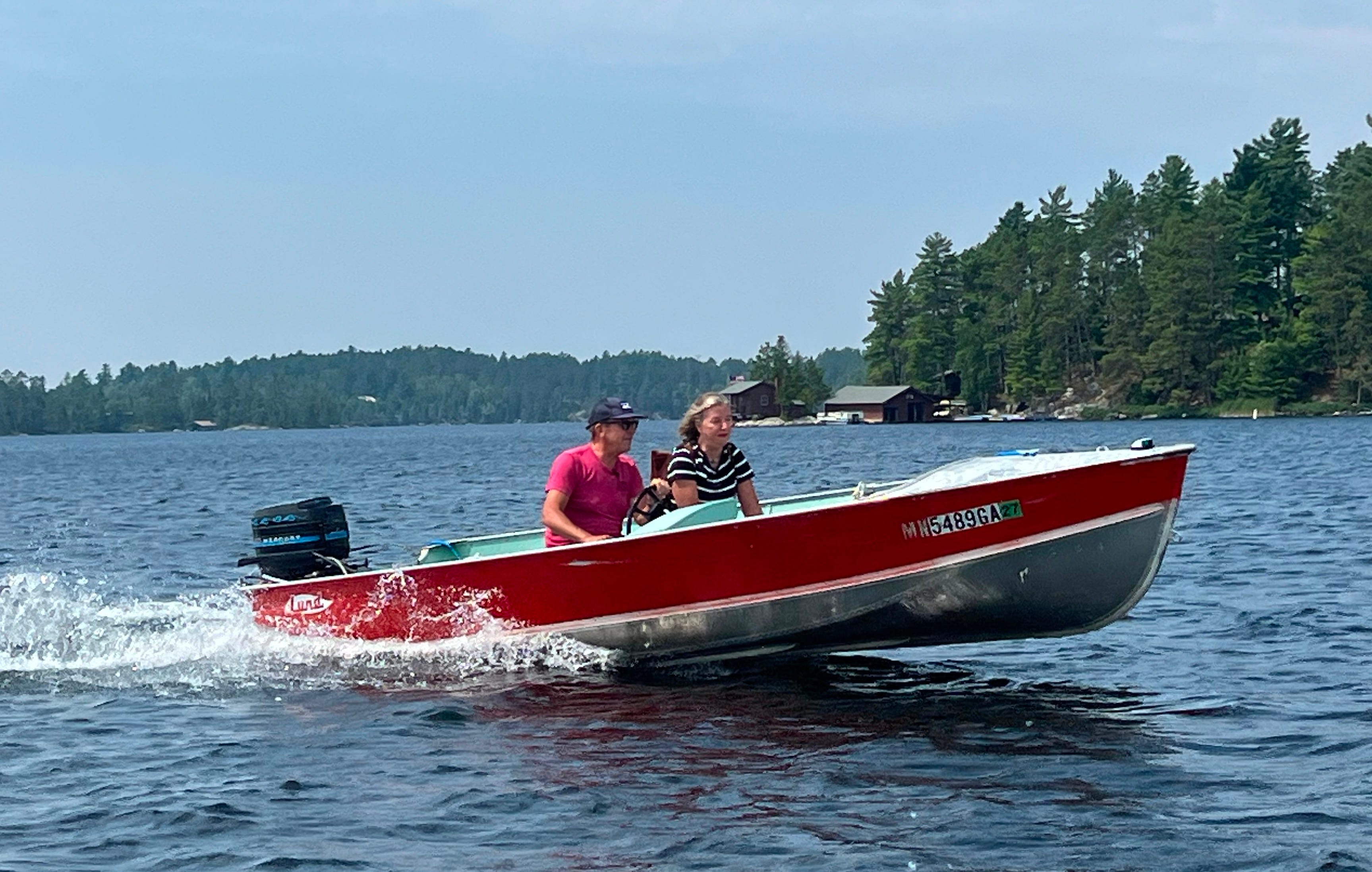
Let’s start with the pig.
I spend my summers up in Ely, Minnesota, on Burntside Lake. I’ve been going up there and staying on True North Island since my father first purchased the place in 1971. I was twelve. Over those years, I’ve seen my share of bears, deer, wolves, loons, ducks, bobcats, foxes, beavers, otters, and possibly more. Then, around 2014, Stephanie and I bought a small one-bedroom cabin on a hill overlooking the lake. We bought it on Craigslist, and at the time, it was the cheapest lakeshore property ever offered. We call it Hilltop. On the drive to Hilltop one morning, I came across a pig.
Pigs aren't indigenous to Minnesota, so I was surprised to see one walking along the road, snorting and wagging its tail. I stopped, and a woman coming the other way with her leashed dog also stopped. She was frightened, though her dog seemed more interested in the new plaything. I stood between the woman with her dog and the happy pig. This thing weighed around five hundred pounds, so she had good reason to be scared. We all watched as the pig sauntered off, wagging its tail, and returning to where it might have escaped its pen. I assumed that this was a pet pig. The woman thanked me profusely for intervening and saving her and her dog from a pig attack. I replied, “You're welcome.”
I think the pig was an omen of crazy things yet to happen.
Then, the runaway fishing boat.
A month later, our friend Dylan got thrown from his fishing boat. I was on the island when I got a call. This was Dylan’s sister, and she was over-the-top hysterical. Dylan had been driving the boat fast when he took his hands off the steering wheel (never a good idea). The boat took a tight turn, and the force knocked him into the water. Now the boat was spinning in circles, and Dylan was in danger of being run over by his own boat—he might have already been clipped and chopped up by the propeller like a carrot in a Cuisinart.
I jumped in my fishing boat and headed his way. I saw Dylan’s boat, seventy horsepower on full throttle, going in tight circles, round and round, jumping its own wake. No one at the wheel. A couple of boats were already there, and I asked the driver of one if the guy had gotten out of the water. “I don’t know.”
I kept going. The next boat was a pontoon. Thankfully, I saw Dylan standing on the deck. He was wrapped up in a towel, visibly shaken, but safe. Thank God. But the boat was still going in circles. I asked Dylan how much gas was in the tank. He replied, “Full.” That’s five gallons. At maybe three gallons an hour, we were looking at an hour and a half before the boat stopped—or prematurely stopped by an outcrop of rocks on the nearby island. Dylan was driven back to his cabin, while I stayed out on the lake, waited and watched.
The Sheriff and Volunteer Fire Department showed up in their boats and dutifully warned everyone back. Like me, they watched. The boat kept spinning in circles but slowly drifted toward the nearby island (and rocks). The Sheriff decided to act. The Volunteer Fire Department guys told me to move further back. I complied. The Sheriff let out a long line and tried to match the runaway boat's movement. They then crossed in front, dragging the line, trying to foul the prop. They were not successful.
The boat drifted closer to the island and then, miraculously, drifted back out into deeper water. It was close to my hour-and-a-half estimate before the boat ran out of gas and stopped.
Then, the fire.
The summer had turned hot and dry. A storm came through, and the lightning ignited fires across the Superior National Forest and the Boundary Waters Canoe Area. The fire wasn’t threatening Burntside or Ely then, and Stephanie and I went down to Grand Marais for a book signing. We stayed the night in our campervan and then headed back the next morning. The wind had picked up, and the fires, some nearly contained, went out of control. Driving into Ely, we saw huge plumes of smoke from about five fires circling the northern horizon.
We made it to Hilltop. Minutes later, I stepped onto the deck and saw the island directly across from True North Island burst into flames. We rushed to the boat and sped out onto the lake. We reached the burning island and looked for any signs of people trying to get off. No one was there. Then we went to our island where my ninety-three-year-old mother was staying with my niece, her husband, and their three-month-old baby. True North Island lay north of the burning island, and the wind blew from the west. Safe for now.
But what do you do? Panic? (For sure!) Stay and spend the night watching to see if our island caught on fire? Or flee? The fire bombers came first, a squadron of three planes that dumped gallons of water on the spreading flames. Then the Volunteer Fire Department guys came out in their fishing boat, outfitted with a fire pump. They put out the biggest flames. We were still freaked out. If we stayed, we would still need to watch for the fire to reignite. And then, remember, we were surrounded by plumes of smoke from the other fires in the Northwoods that were actively spreading. No sense putting our lives at risk. So, we fled.
(Side note: Our island neighbors rented out their place to a knucklehead who let his kids set off fireworks. They also lit a campfire as the world was burning down. Either the campfire's unextinguished embers or smoldering fireworks started the fire. They showed up as I watched the island burn; they came in their two-hundred-thousand-dollar wakeboard boat to watch their few belongings disappear in flames. I heard a few screams, and then they were off. Never to be seen again.)
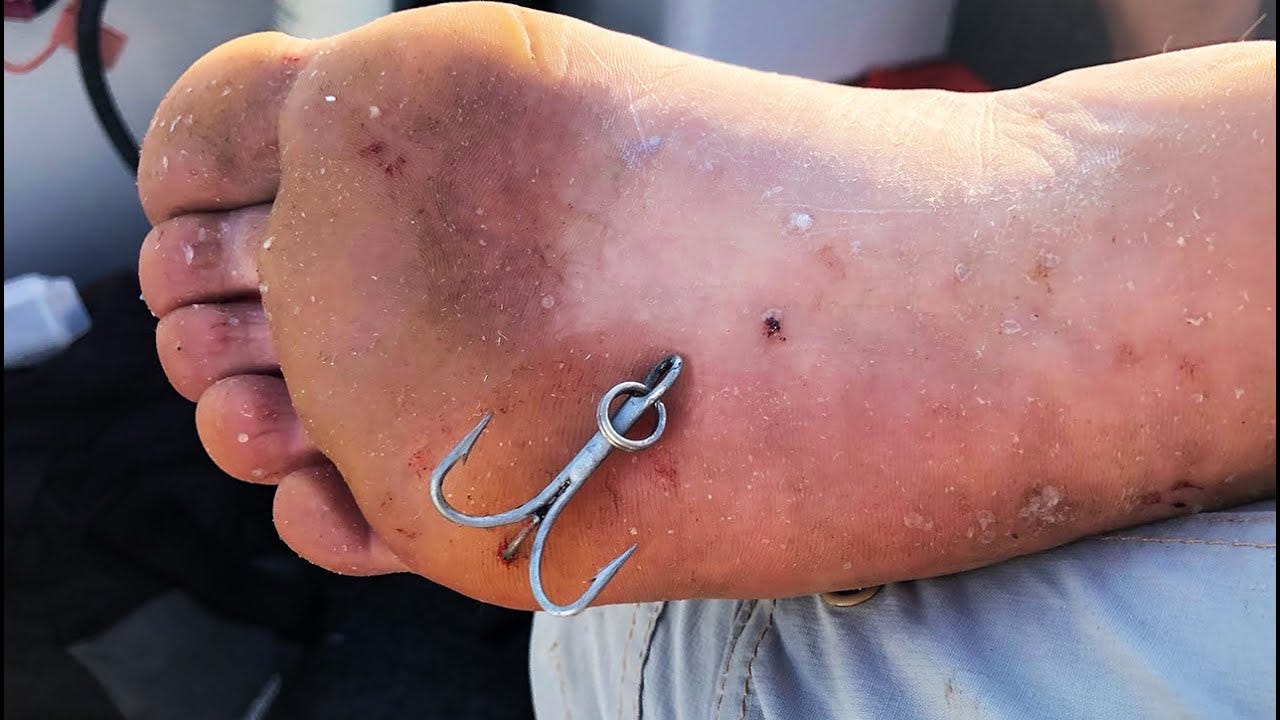
Then the fishhook.
Dylan’s cousin stepped on a treble hook while I maneuvered my boat onto their dock. Long story short, I pushed the barbed hook through the calloused sole of his foot, clipped off the barb, then pulled it back out.
That’s it for the strange summer. But I’m missing something. Stories need meaning—the hero (me) comes back to the real world with new insight into his life, things he learned on his journey. What was it I learned? What can I take from this very strange summer of stray pigs, out-of-control fishing boats, wildfires, and embedded treble hooks?
Here’s what AI had to say:
The pig acts like a comic omen: something harmless but wildly out of place, announcing that normal rules are about to loosen.
The runaway boat makes danger literal. Once Dylan lets go of the wheel, the machine keeps circling without anyone in control—an image of how quickly a small lapse can create consequences that cannot immediately be stopped.
The wildfire enlarges that loss of control. Human carelessness, dry weather, and shifting wind combine into a threat that overwhelms individual plans. The sensible response is not heroism but humility: recognize the danger and leave.
The fishhook brings the pattern down to the smallest scale. Even a routine act like stepping into a boat can suddenly become painful and require calm, practical action.
Ok, that’s pretty fucking good. But what does it MEAN?
Not a clue. If you have an idea, let me know.
AI Overview
Your AI’s initial breakdown is a great foundation—it correctly identifies how the scope of danger scales from a routine mistake to a massive, macro-level threat. However, to truly unearth the "hero’s insight," we can look past the literal chain of events and pull out the overarching philosophical and moral lessons about human nature and our relationship with control.
Here are the deeper, overarching themes and moral lessons you can take away from your strange summer in Ely:
1. The Narrative Arc of Control (The Core Insight)
The true breakthrough of your summer is the realization that control is an illusion, but responsibility is not.
• The Progression: Your summer shows a perfect continuum of how control slips away. It starts with the pig (a bizarre but harmless break in reality), escalates to Dylan (losing mechanical control), explodes into the wildfire (losing environmental control), and finishes with the fishhook (a tiny, sensory reminder of our vulnerability).
• The Lesson: You learned that while you cannot prevent the world from spinning out of handle, your power lies entirely in how you respond. You didn’t panic; you evaluated, waited, adapted, and acted practically. True maturity is transitioning from trying to dominate your surroundings to mastering your own response within them.
2. The Danger of "Letting Go of the Wheel" (The Moral Lesson)
Dylan’s runaway boat and the neighbors' fireworks represent two sides of the same coin: passive and active carelessness.
• The Lesson: Small lapses in mindfulness have compounding, independent consequences. The moment Dylan let go of the wheel, the boat became a self-sustaining hazard that didn't care about his regret. Similarly, the "knucklehead" neighbors ignored a burning world to light fireworks, letting a tiny spark consume their possessions. The moral here is that the universe doesn’t hit "pause" when we become careless; it accelerates.
3. True Heroism is Practical, Not Performative
The story subtly critiques modern, performative status versus quiet, useful competence.
• The Contrast: The neighbors own a $200,000 wakeboard boat but are completely powerless, screaming as their life catches fire due to their own foolishness. The Sheriff tries a dramatic cinematic maneuver (fouling the prop with a line) and fails.
• The Lesson: You, on the other hand, calculated the fuel math, waited out the hour-and-a-half, pushed the fishhook through to clip the barb, and chose to evacuate your family safely rather than stay to play the macho protector against a wildfire. You learned that real survival and leadership rely on basic math, patience, and humility, not grand gestures.
4. The World is Radically Interconnected
A stray pig, a runaway boat, a lightning strike, and a misplaced foot feel like a string of random bad luck. In reality, they reveal how tightly bound we are to our environments.
• The Lesson: A dry summer in the Superior National Forest links a thunderstorm to a family evacuating an island. An unanchored boat links a driver to a nearby rocky outcrop. The moral lesson is a call to heightened awareness: we do not live in a vacuum. What we do—or fail to do—reverberates into the lives of everyone sharing the lake.
Bizarre.Interesting series of events for sure. Just random events with no hidden meaning I think. Wounder what next summer events will put in your path!?!?